

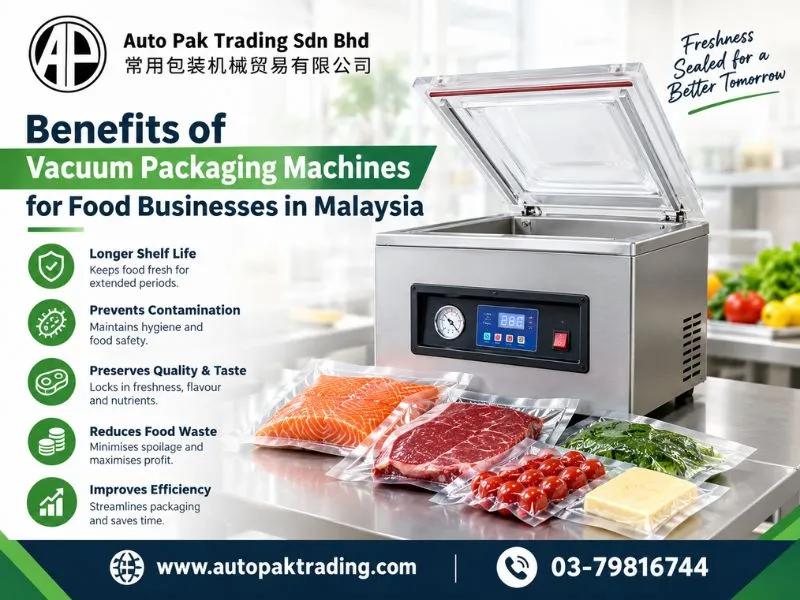
Vacuum packaging machines extend food shelf life by removing oxygen from packaging, which slows bacterial growth and oxidation. For food businesses, this means reduced spoilage, lower waste costs, and better product consistency. In Malaysia's humid tropical climate, vacuum sealing is especially critical for maintaining food quality across production, storage, and distribution cycles.
If you run a food manufacturing unit, a frozen food brand, or a restaurant in Malaysia, a vacuum sealer machine Malaysia is no longer a luxury — it is a core operational tool. The stakes are high: food spoilage costs Malaysian food businesses millions annually, and consumer expectations for freshness and hygiene have never been higher.
Why Vacuum Packaging Matters for Malaysian Food Businesses
Malaysia's climate is a constant challenge for food storage. High humidity and year-round heat accelerate microbial growth and shorten the natural shelf life of perishable goods. A vacuum packaging machine removes up to 99% of air from a food package before sealing, creating an environment where aerobic bacteria cannot survive.
According to the Malaysia Productivity Corporation (MPC), post-harvest food losses in Malaysia account for a significant portion of the food supply chain inefficiency. Businesses that adopt automated food packaging solutions report measurable reductions in product returns and waste disposal costs.
Key Benefits of Using a Vacuum Sealer Machine for Food Businesses
1. Significantly Extended Shelf Life
This is the most immediate benefit. Vacuum-sealed fresh meat can last up to 3–5 times longer compared to conventionally wrapped products. Dry goods and processed snacks sealed with a food vacuum sealer show minimal quality degradation even after several weeks in storage.
For frozen food businesses in Malaysia, this translates directly into expanded distribution reach — products can travel further across Peninsular Malaysia or to East Malaysia without compromising texture or taste.
2. Protection Against Moisture, Freezer Burn, and Contamination
Moisture infiltration is one of the leading causes of premature spoilage in tropical climates. Vacuum food packaging creates a tight barrier that prevents external moisture from entering the package. This is especially valuable for businesses storing seafood, poultry, marinated meats, and ready-to-cook products.
Freezer burn — a common problem in frozen food operations — occurs when food is exposed to air inside packaging. Vacuum sealing eliminates this risk entirely, preserving the product's colour, texture, and nutritional value.
3. Improved Packaging Consistency Across Production Runs
Manual packaging introduces human error: inconsistent seal strength, trapped air pockets, and variable bag sizes. A commercial vacuum packaging machine standardises every pack — same seal quality, same vacuum level, same presentation every time.
This consistency matters most for businesses supplying supermarkets, hotel kitchens, or food service distributors in Malaysia, where packaging presentation directly affects brand perception and retail acceptance.
4. Cost Savings Through Reduced Food Waste
Food waste is a measurable cost. When products spoil before reaching the end customer, the business absorbs the full cost — procurement, processing, labour, and logistics. Vacuum sealing dramatically reduces this loss cycle.
Lower product return rates from retailers
Reduced daily write-offs in restaurant and catering operations
Longer usable inventory window, reducing emergency restocking
Less reliance on preservatives, which lowers ingredient costs
Over time, the return on investment from a food packaging machine becomes clear — especially for businesses operating at scale.
5. Compliance with Malaysian Food Safety Standards
The Food Act 1983 and Food Regulations 1985, enforced by the Ministry of Health Malaysia (MOH), set clear standards for food hygiene and packaging. Vacuum packaging supports compliance by reducing contamination risks and extending the integrity of sealed products throughout the cold chain.
Businesses supplying to supermarkets, hotels, or export markets increasingly require documented packaging standards. Using certified vacuum sealing equipment helps food businesses meet these requirements more consistently.
6. Better Storage Efficiency and Space Optimisation
Vacuum-sealed bags compress products into a more uniform, stackable shape. This directly improves storage density in cold rooms, refrigerators, and freezer units — a practical advantage for any food business paying for commercial refrigeration space in Malaysia.
A restaurant that vacuum-seals its marinated proteins, for example, can store twice the inventory in the same chiller space compared to loose or conventionally wrapped storage. That is a real operational gain, not just a theoretical one.
Vacuum Sealing vs. Conventional Packaging: A Quick Comparison
Factor | Vacuum Packaging | Conventional Packaging
|
|---|---|---|
Shelf life extension | 3–5x longer | Standard (baseline) |
Moisture protection | High — sealed barrier | Low — air exposure |
Freezer burn risk | Eliminated | Common |
Packaging consistency | Automated and uniform | Variable (manual) |
Storage efficiency | High — compressed, stackable | Moderate |
Food waste reduction | Significant | Limited |
Which Types of Food Businesses Benefit Most?
Almost every food business in Malaysia can gain from vacuum sealing, but the impact is most pronounced in these sectors:
Frozen food manufacturers — consistent sealing quality supports retail listing requirements and longer logistics windows
Restaurants and central kitchens — mise en place preparation, batch cooking, and marinated protein storage become significantly more efficient
Seafood and meat processors — moisture retention and extended shelf life directly improve product value at point of sale
Snack and dry food producers — vacuum sealing protects against humidity-related softening, clumping, or oxidation
Catering and food delivery businesses — pre-portioned vacuum packs streamline operations and reduce waste per order
What to Look for in a Vacuum Packaging Machine
Chamber vs. External Vacuum Sealers
Chamber vacuum sealers are designed for commercial use. The entire bag is placed inside the chamber, and air is extracted uniformly before sealing. This produces a stronger, more consistent vacuum — ideal for liquid-rich foods like soups, sauces, or marinated meats.
External vacuum sealers are more compact and suited to lower-volume operations. They work well for dry or semi-dry products but are less effective for liquids.
Key Specifications to Evaluate
Vacuum pump capacity — determines the depth and consistency of the vacuum
Seal bar length — must match your packaging width requirements
Cycle speed — critical for high-volume production lines
Bag compatibility — ensure the machine supports the film thickness and material you use
Build material — stainless steel construction is standard for food-grade compliance
Making the Switch: What Malaysian Food Businesses Should Know
Transitioning to vacuum packaging does not require a full facility overhaul. Many businesses start with a single chamber machine and scale up as production volumes grow. The key is matching machine capacity to current throughput while building room for growth.
Training requirements are minimal — most commercial vacuum sealers are designed for operator ease. The more significant investment is in sourcing the right vacuum pouches and ensuring your cold chain infrastructure supports the extended shelf life the sealing provides.
For businesses looking at the full range of vacuum sealing solutions — from tabletop models to fully automated lines — Autopak Trading offers a comprehensive selection of vacuum sealer machines suited to Malaysian food industry requirements.
Frequently Asked Questions
How long does vacuum-sealed food last compared to regular packaging?
Vacuum-sealed food typically lasts 3–5 times longer than conventionally packaged food. Fresh meat sealed under vacuum can last up to 2–3 weeks in the refrigerator compared to 3–5 days in standard wrapping, significantly reducing spoilage and product waste for food businesses.
Is a vacuum packaging machine suitable for small food businesses in Malaysia?
Yes. Compact chamber vacuum sealers are available at accessible price points and are well-suited for small restaurants, catering operators, and artisan food producers. Even low-volume operations benefit from reduced spoilage, improved presentation, and better cold storage efficiency when using vacuum packaging.
Does vacuum packaging comply with Malaysian food safety regulations?
Vacuum packaging supports compliance with the Food Act 1983 and Food Regulations 1985 by reducing contamination risks and maintaining product integrity throughout storage and distribution. It does not replace proper food handling practices but is a recognised method for improving food hygiene standards.
What types of food can be vacuum sealed?
Most solid and semi-solid foods can be vacuum sealed, including meats, seafood, vegetables, cheese, nuts, dried goods, and marinated products. Liquid-heavy foods like soups or sauces require a chamber vacuum sealer rather than an external model to prevent liquid from entering the seal area.
What is the difference between a chamber vacuum sealer and an external vacuum sealer?
A chamber vacuum sealer places the entire bag inside the machine and removes air from the whole chamber, producing a stronger, more consistent seal — ideal for commercial use. An external sealer only vacuums air directly from the bag opening and is better suited for dry, low-volume products.
How do I choose the right vacuum sealer machine for my food business?
Consider your daily production volume, the types of food you package, and whether you handle liquids. Key specs to evaluate include pump capacity, seal bar length, cycle speed, and food-grade construction. A chamber model with stainless steel build is the standard recommendation for most commercial food operations in Malaysia.